
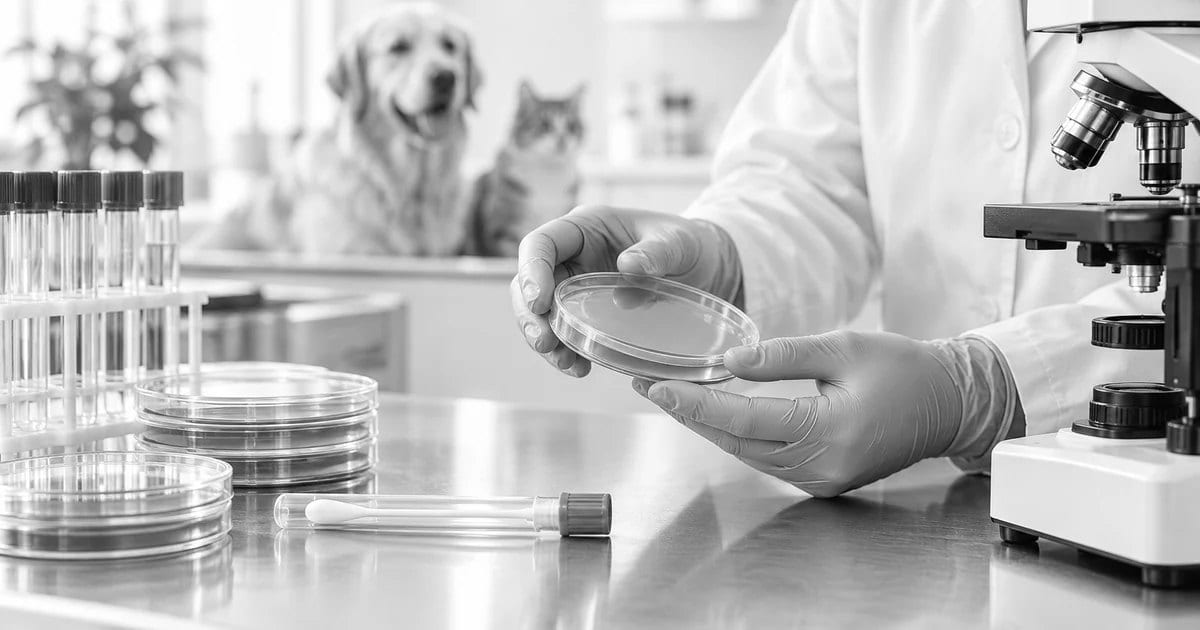
Bacterial culture asks which bacteria can be grown from a submitted sample under the test conditions. Antibiotic susceptibility testing examines how an identified isolate responds to selected antibiotics in laboratory testing. The veterinarian combines those findings with the animal’s condition to decide what they mean.
Why are these separate investigations?
Culture, identification and susceptibility are related steps, but they are not interchangeable labels. A request form should make the clinical question clear.
Cornell’s bacteriology laboratory lists culture and organism identification with susceptibility testing as distinct services. That describes the disciplines involved; it is not a statement that every laboratory offers the same panel or method.
For your own submission, confirm what is included, whether an additional test might be needed and who will receive the result.
What information should the clinic send?
The sample site matters. “Swab” is less informative than an accurate description of the site and how the specimen was collected. Where several sites are sampled, keep the specimens and labels distinct.
A useful request includes:
- Animal identification and species.
- Exact collection site.
- The clinical question and relevant signs.
- Collection date, time and method.
- Treatment history supplied by the treating clinic.
- Any concern about the specimen’s handling or transport.
The laboratory should confirm the correct specimen, container or transport medium before collection. Do not send a fixed biopsy specimen when a fresh specimen was requested. The biopsy submission guide explains why fixed and fresh material serve different investigations.
How should an owner read the report?
Start with the specimen description and laboratory comments. Ask whether the organism reported fits the sampling site and clinical picture. Do not interpret an organism name without the veterinarian’s assessment.
If susceptibility results are included, ask the veterinarian to explain the test categories and their relevance to the animal. A laboratory result does not, by itself, select a medicine, route, dose or duration.
The Merck Veterinary Manual’s microbiology guidance explains why specimen handling and patient-specific interpretation matter. Keep a complete copy of the report. Cropping out the sample details or comments can remove information needed for interpretation.
What questions help at follow-up?
A practical discussion can focus on three points: Did the specimen answer the intended question? Is further investigation needed? What is the plan for monitoring the animal?
If the report does not resolve the problem, the veterinarian may discuss another specimen or a different investigation. Do not assume that repeating the same sample automatically gives a more useful answer.
Clinics considering eLAB Diagnostics can use the veterinarian page or call 1800 889 1900 to confirm current availability and submission requirements.
Frequently asked questions
Does “no growth” mean there is no infection anywhere?
No. It describes the result for the submitted specimen under the test conditions. Ask how it fits the case.
Should I stop prescribed antibiotics before sampling?
Do not change prescribed treatment yourself. Ask the treating veterinarian how to plan the investigation.
Does every culture include susceptibility testing?
Do not assume it does. Confirm the requested investigation and what the laboratory includes.
Can I choose an antibiotic from the report?
The treating veterinarian should make that decision using the whole case, including the report and examination.